Vinyl Flooring
Vinyl Wood-Look Grain: Reading the Print at Full Plank Size
A small wood-look vinyl chip can hide much of the printed design. Learn to review full planks, grain scale, knots and repetition, then record an appearance choice separately from construction and performance evidence.
Quick answer
Wood-look vinyl uses a decorative image rather than a timber wear surface. Review that image at full plank size and across several pieces. Grain scale, knots, tone and repetition affect appearance; they do not establish wood species properties, wear performance or installation suitability.
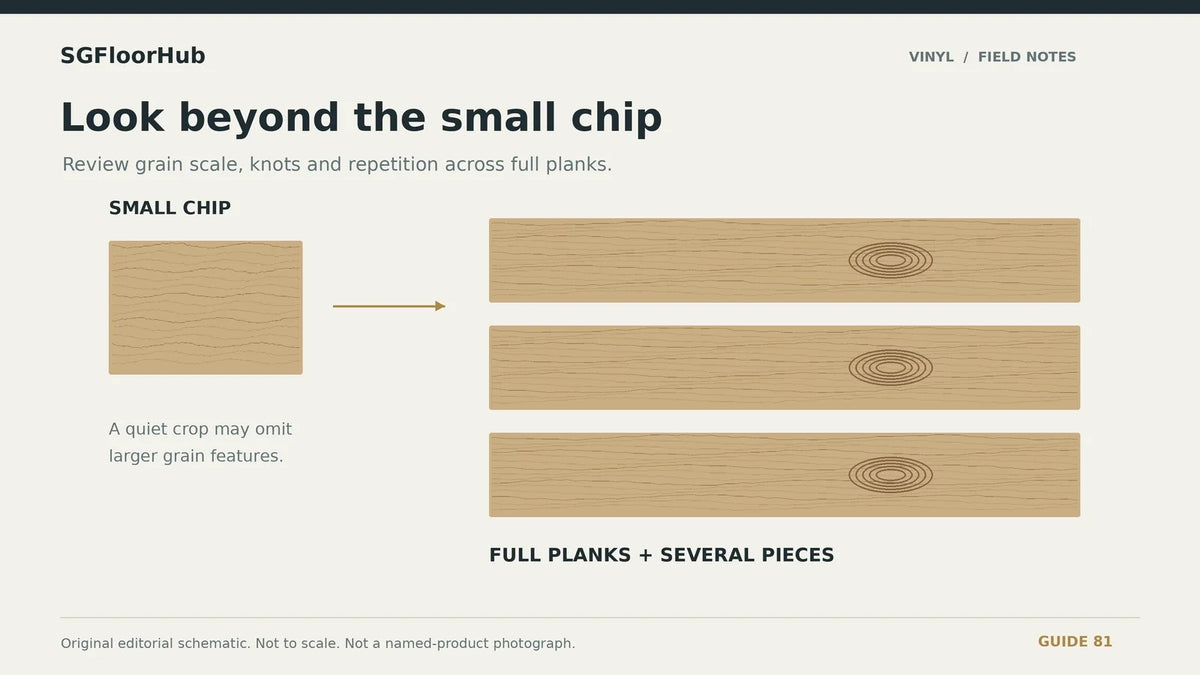
Cover: Original SGFloorHub editorial schematic created for this article. It is not to scale and does not depict a named-product cross-section or completed project.
Read the image at the scale you will actually see
A small sample can show colour and local texture while omitting a large knot or grain feature elsewhere on the plank. View the full supplied format before deciding how much visual character suits the room. A crop on a website is a design preview, not a complete appearance approval.
Karndean’s Van Gogh range describes wood-inspired designs in more than one format. The inspiration helps explain the decor, but does not make the surface natural wood or give it the properties of the named timber.
Record both the design and the supplied format. The same image family shown at a different plank proportion can create a different rhythm in the room.

An appearance review with separate fields
| Field | What to observe |
|---|---|
| Grain scale | How large the printed features appear relative to the plank. |
| Character | Knots, contrasting marks and quieter areas. |
| Tone | Warm/cool appearance under the intended lighting. |
| Repeat | Recurring images across a representative group. |
| Surface relationship | Texture, gloss and any documented registration with the print. |
These are aesthetic observations. Avoid turning “realistic” or “natural” into a technical rating. A preferred printed grain can still require the same construction and evidence checks as another candidate.
Example: a calm chip and a busy full board
Editorial illustration: a small pale-oak chip looks calm beside cabinetry. The full plank includes a prominent dark knot, repeated in several pieces of the display. The buyer may still like it, but the approved appearance should reflect that character rather than the quiet crop alone.
Lay several labelled pieces together in a permitted display arrangement and view them from the doorway as well as close up. Note the source and limitations of the display. It need not reproduce a complete installation to answer the narrow question about visible character.
Do not declare an exact repeat count from a few sample pieces. Ask for the manufacturer’s stated design variation if repeat count is part of the selection brief.
Keep the appearance approval connected to the order
Retain the product code, colour/design reference, format, sample photographs and date. If the supplier proposes a related construction, confirm whether its printed design and texture match the approved reference.
Technical datasheets address dimensions and construction separately from the image. Use them to keep the chosen visual attached to the correct product, not to replace a physical appearance review.
For Singapore interiors, compare the design beside the planned wall, cabinetry and lighting. That local viewing exercise is more useful than assuming a photograph from another room predicts yours. This article owns grain character and scale; the EIR article owns texture alignment and the sample guide owns the overall approval process.
Frequently asked questions
Does an oak-look print behave like oak timber?
No. It describes the decorative appearance of the vinyl, not a timber surface.
Can a small chip show the whole grain design?
Often it shows only a portion. Review the full format and representative variation before approval.
Does a repeated grain mean a defective product?
Printed designs can repeat. Compare the actual visual range with the manufacturer description and the approved appearance.
Sources and scope
Sources checked on 14 October 2026. Manufacturer examples explain their named products and regions; they do not confirm Singapore stock or approval of your project. Labelled scenarios are editorial illustrations, not measurements or site investigations.
Continue reading
Written by SGFloorHub Editorial. Updated 15 October 2026. Editorial method · Suggest a correction
Independent editorial guidance. Check the current documents for the exact product and project.
Editorial standardsSuggest a correctionCONTINUE READING
More from this subject.

Vinyl Flooring
Large-Format LVT: Specify the Module Before the Look
Large-format describes proportion, not a performance grade. Define the actual module and review how it meets the room edges and fixed features.
Read article Large-Format LVT: Specify the Module Before the Look
Vinyl Flooring
LVT Grout Effects: Printed Lines, Bevels or Separate Strips?
A grout effect may be printed, formed at the edge or made with a separate strip. Identify the detail before choosing the tile and layout.
Read article LVT Grout Effects: Printed Lines, Bevels or Separate Strips?
Vinyl Flooring
Vinyl Sheet Roll Widths: Understanding Product Options
Roll width is a supplied-product dimension that needs a matching design and construction reference. Learn how to read a real width example, distinguish nominal format from a lay...
Read article Vinyl Sheet Roll Widths: Understanding Product Options