Vinyl Flooring
LVT Construction: What Each Layer Actually Does
Understand what the layers in an LVT plank actually do. This guide separates surface treatment, wear layer, printed design and supporting construction, using manufacturer examples to explain why a product cross-section must be read with its own documentation.
Quick answer
LVT is a layered product, but the stack varies by format and manufacturer. Surface treatment, wear layer and printed design are different components. Supporting layers and backing complete the construction. Identify the exact product before assigning a function or performance claim to any visible layer.
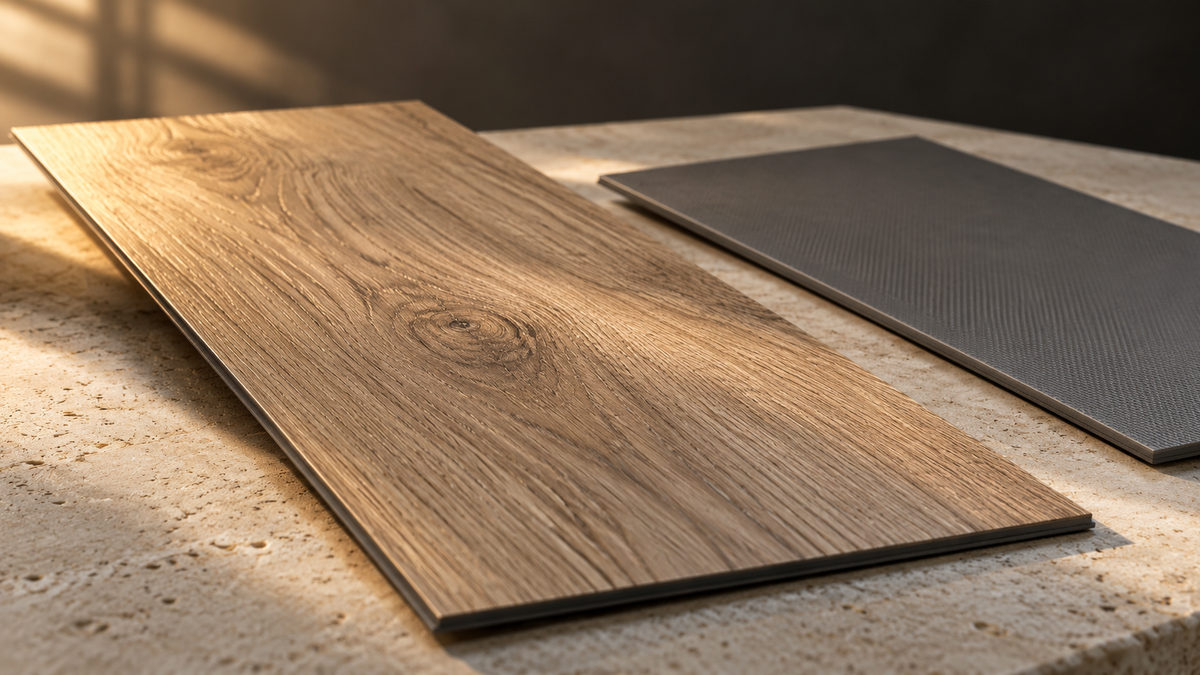
Cover: AI-generated editorial illustration of generic flooring materials or a sample layout. It is not a photograph of a named-brand product or completed project, nor a verified construction or locking profile. The in-article diagram is an original SGFloorHub schematic, not to scale.
Start with the correct cross-section
A wood-look face does not tell you whether the plank is flexible gluedown, friction-backed loose lay or a rigid locking construction. Those products can share an appearance while using different support and fixing arrangements. The cross-section is therefore a map of the selected product, not a diagram for every vinyl floor.
Karndean’s Australian construction explanation distinguishes surface protection, clear PVC wear layer, photographic design and stability components, with format-specific backing or locking features. Forbo’s Allura construction diagrams also separate the printed design, glass-fleece components and backing. These examples establish the need to read the named configuration; they do not establish one universal layer count.
When using a diagram, record the collection and format beside it. A diagram copied from a rigid-core range should not accompany a specification for a gluedown product merely because the colour name matches.

The functions readers most often confuse
| Component | What it describes | What it does not establish alone |
|---|---|---|
| Surface treatment | The factory-applied finish or protection system. | The full thickness of the wear layer. |
| Wear layer | The wearing surface specified by the manufacturer. | Overall board gauge or predicted lifespan. |
| Decor layer | The printed appearance of wood, stone or another design. | Real timber species, natural-stone composition or performance. |
| Supporting construction | The named stability, carrier or core arrangement. | A guarantee that the substrate can remain unassessed. |
| Backing / pad | The underside and any attached supporting layer. | Permission to add another loose underlay. |
The table is a reading framework. Some configurations combine functions or use different terminology. Copy the manufacturer’s layer names first, then explain their role; do not force a product into a five-layer drawing when its documentation shows otherwise.
A sample exercise: same face, different underside
Editorial illustration: two pale-oak samples are on a desk. One has a flat underside and no mechanical edge; the other has a profiled edge and attached pad. Label them A and B, photograph the supplied codes and obtain the document for each. Do not identify the unseen chemistry by colour or decide that the padded sample is automatically superior.
Build a short record with four lines: visible construction, manufacturer description, stated measurement and unresolved question. For example, an attached layer might be visible but its material and thickness remain unconfirmed. Keeping that distinction is more useful than calling it “acoustic foam” without a source.
This exercise supports material identification. It is not a bending, scratch, heat or water test. Household demonstrations are not substitutes for the methods stated in a technical report.
Connect the layer map to a Singapore purchase
Ask the supplier to match the sample, quotation and current regional document to one code and format. If an imported product is proposed, confirm the supplied specification and local support rather than assuming an overseas web page describes available Singapore stock.
The layer map then feeds separate decisions: wear-layer figures go to the thickness comparison, locking details go to the permitted installation system, and attached backing goes to its assembly instructions. It should not grow into a second general vinyl buying guide.
Keep one approved configuration in the order record. If the supplier changes the format or backing later, revisit the map and affected evidence before accepting the substitution. A retained sample without a code is an appearance reference with incomplete product identity.
Frequently asked questions
Is the surface coating the wear layer?
They may be listed as separate components. Use the manufacturer’s terminology and measurements rather than treating every protective feature as the same layer.
Does every LVT have fibreglass?
No blanket layer stack is appropriate. Check the exact construction and supporting documents.
Can I tell performance by counting layers?
No. Layer count is not a performance score. Construction, intended use and relevant test evidence need to be considered together.
Sources and scope
Sources checked on 14 October 2026. Manufacturer examples explain their named products and regions; they do not confirm Singapore stock or approval of your project. Labelled scenarios are editorial illustrations, not measurements or site investigations.
Continue reading
Written by SGFloorHub Editorial. Updated 14 October 2026. Editorial method · Suggest a correction
Independent editorial guidance. Check the current documents for the exact product and project.
Editorial standardsSuggest a correctionCONTINUE READING
More from this subject.

Vinyl Flooring
Large-Format LVT: Specify the Module Before the Look
Large-format describes proportion, not a performance grade. Define the actual module and review how it meets the room edges and fixed features.
Read article Large-Format LVT: Specify the Module Before the Look
Vinyl Flooring
LVT Grout Effects: Printed Lines, Bevels or Separate Strips?
A grout effect may be printed, formed at the edge or made with a separate strip. Identify the detail before choosing the tile and layout.
Read article LVT Grout Effects: Printed Lines, Bevels or Separate Strips?
Vinyl Flooring
Vinyl Sheet Roll Widths: Understanding Product Options
Roll width is a supplied-product dimension that needs a matching design and construction reference. Learn how to read a real width example, distinguish nominal format from a lay...
Read article Vinyl Sheet Roll Widths: Understanding Product Options