Vinyl Flooring
PUR Vinyl Finishes: Reading the Manufacturer's Claims
PUR is a surface-treatment term that needs the manufacturer’s context. Learn how to read a named treatment, distinguish it from the wear layer and evaluate which claims require separate evidence before specifying a vinyl product.
Quick answer
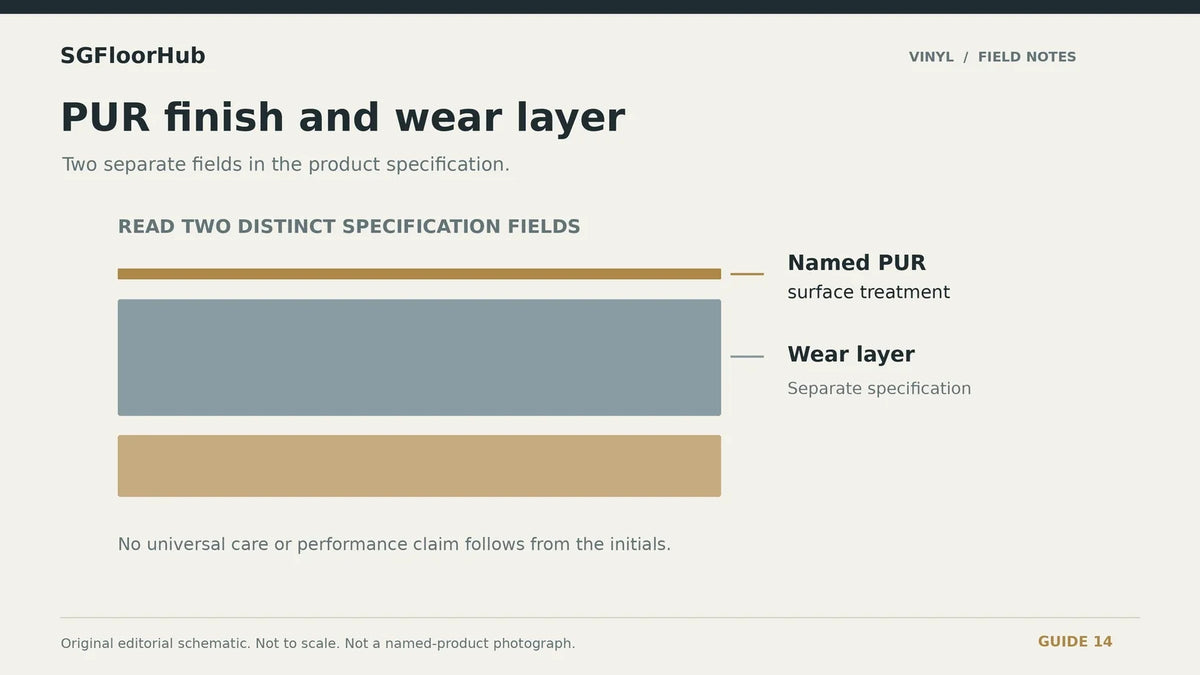
PUR commonly refers to a polyurethane surface treatment or reinforcement in a manufacturer’s vinyl description. It is separate from the complete wear-layer specification. The term alone does not establish a universal formula, maintenance regime, scratch rating or performance guarantee for every floor.
Cover: Original SGFloorHub editorial schematic created for this article. It is not to scale and does not depict a named-product cross-section or completed project.
Read the named treatment before interpreting the initials
Polyflor’s LVT PUR document describes a cross-linked, UV-cured polyurethane reinforcement in its product context. This tells you about that manufacturer’s surface system. It should not be rewritten as the exact coating chemistry or instructions for an unrelated range.
A surface-treatment description and a wear-layer measurement belong in different fields. One names a finishing technology; the other states a specified component’s measurement. Combining them into a single “protective layer” can hide information the buyer needs.
Keep the brand’s exact treatment name, range and document. If only PUR is supplied in a sales sheet, ask which product-specific claims the manufacturer actually makes.

Sort the claim into the evidence it needs
| Claim | Where to look |
|---|---|
| Named factory treatment | Product construction and surface-treatment description. |
| Wear-layer measurement | Datasheet field and stated method. |
| Scratch or stain result | Relevant tested property and product scope. |
| Care requirements | Current care instructions for the installed range. |
| Warranty remedy | Applicable local terms and covered event. |
A surface treatment cannot act as one certificate covering all of those questions. Nor should a factory finish be treated as permission for a site-applied polish or restoration coating.
Example: “polish free” without the correct range
Editorial illustration: a brochure for one treated collection describes a particular care approach. A supplier offers a different range but repeats the same phrase. Ask for the offered range’s care and treatment documents rather than transferring the brochure statement.
Record what the phrase means in the source. It may describe a defined maintenance arrangement, not an absence of all cleaning or a guarantee against every mark. A buyer can retain the claim with its conditions without needing to invent a universal PUR benefit.
Tarkett’s Standard Plus specification also lists PUR treatment on a homogeneous product. That example shows that the surface term does not itself identify whether the wearing construction is homogeneous or printed layered LVT.
A focused surface-treatment entry in the product pack
Keep a short entry: exact product, treatment name, manufacturer statement, supporting document and unresolved claim. That entry belongs beside the wear-layer field, not in place of it.
For Singapore procurement, obtain the current supplied-product and local support documents. An overseas manufacturer example explains terminology; it does not approve a particular local cleaning contractor’s proposed chemical or machine.
This guide addresses the finish description. Follow the vinyl-care article for routine operation and the technical evidence guide for report verification, so the material article does not become another general maintenance checklist.
Frequently asked questions
Does PUR tell me the wear-layer thickness?
No. Record the surface treatment and wear-layer measurement separately.
Does PUR mean no maintenance?
No. Read the actual product’s care instructions and the scope of any maintenance claim.
Can I apply another coating over PUR vinyl?
Use the installed product’s permitted treatment instructions. Do not infer permission from the initials.
Sources and scope
Sources checked on 14 October 2026. Manufacturer examples explain their named products and regions; they do not confirm Singapore stock or approval of your project. Labelled scenarios are editorial illustrations, not measurements or site investigations.
Continue reading
Written by SGFloorHub Editorial. Updated 15 October 2026. Editorial method · Suggest a correction
Independent editorial guidance. Check the current documents for the exact product and project.
Editorial standardsSuggest a correctionCONTINUE READING
More from this subject.

Vinyl Flooring
Large-Format LVT: Specify the Module Before the Look
Large-format describes proportion, not a performance grade. Define the actual module and review how it meets the room edges and fixed features.
Read article Large-Format LVT: Specify the Module Before the Look
Vinyl Flooring
LVT Grout Effects: Printed Lines, Bevels or Separate Strips?
A grout effect may be printed, formed at the edge or made with a separate strip. Identify the detail before choosing the tile and layout.
Read article LVT Grout Effects: Printed Lines, Bevels or Separate Strips?
Vinyl Flooring
Vinyl Sheet Roll Widths: Understanding Product Options
Roll width is a supplied-product dimension that needs a matching design and construction reference. Learn how to read a real width example, distinguish nominal format from a lay...
Read article Vinyl Sheet Roll Widths: Understanding Product Options