Vinyl Flooring
Dryback LVT: Understanding the Product Format
Dryback describes a vinyl product intended for a specified bonded installation. Learn which product features distinguish it from loose-lay and click formats, how to read a real datasheet and what an approved product identity needs to include.
Quick answer
Dryback LVT is a product format intended for bonding to a prepared base using the specified system. It generally lacks a click-lock connection and must not be treated as loose lay merely because a sample has a flat underside. Read the exact format and installation documentation together.
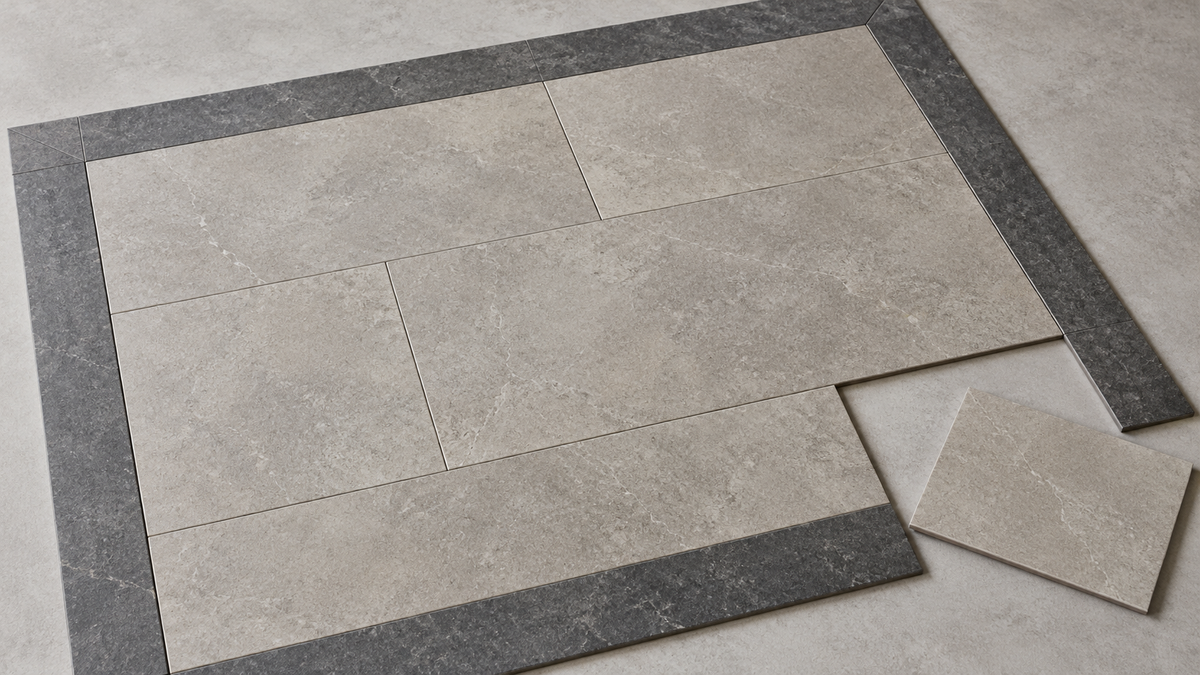
Cover: AI-generated editorial illustration of generic flooring materials or a sample layout. It is not a photograph of a named-brand product or completed project, nor a verified construction or locking profile. The in-article diagram is an original SGFloorHub schematic, not to scale.
Identify the format before comparing features
Karndean’s United States gluedown-format page describes individual planks or tiles secured by adhesive and shows design options such as strips and borders. That is a manufacturer’s product-format explanation, not an installation prescription for every dryback floor.
The format changes what the product needs around it. The delivered material must be paired with its specified adhesive and preparation arrangement. Those supporting products are part of the installation scope even though they are not visible in a loose sample.
A flat underside alone does not tell you the exact bond method. Confirm the manufacturer’s format statement; self-adhesive tiles, tackified products and full-bond dryback are not interchangeable terms.

Read a real dryback specification without turning gauge into a verdict
The Van Gogh Gluedown ANZ datasheet dated 15 October 2025 lists 3.0 mm overall thickness and a separate 0.55 mm wear layer. Its adhesive section forms another part of the specification. These are figures for that document and configuration, not standard values for dryback across the market.
| Product detail | What it helps establish |
|---|---|
| Format and code | Which gluedown product is being offered. |
| Piece dimensions | The module used in the design and supplied quantity. |
| Overall gauge | The product measurement; installed height also includes surrounding work. |
| Surface fields | Wear layer and treatment, kept as separate information. |
| Supporting documents | Installation, care and warranty for the exact product. |
A thinner material is not necessarily inferior to a thicker rigid product. They have different constructions. Compare the completed systems against the brief, not isolated thickness figures.
Example: a decorative border in an entrance
Editorial illustration: a buyer wants a stone-look field with a narrow border. Ask whether the chosen dryback collection supplies compatible field pieces and strips, with the correct size and thickness. A picture of a border is not a schedule of the components needed to reproduce it.
Write the design as a small component list: main code, border or strip code, dimensions, finish and approved layout. Keep colour samples beside it. If the border uses a different range, resolve compatibility rather than assuming all vinyl can be mixed because it can be cut.
This remains a product and design exercise. Cutting, bond testing, substrate acceptance and laying details belong to the selected installation instructions and responsible installer.
What to approve in a Singapore order
Approve the exact product format, design components and relevant documentation before ordering. Ask the supplier to state preparation and accessory assumptions in its proposal. Do not accept a price for the material as though it covers the entire gluedown arrangement.
Keep the original code and approved sample. If a click or loose-lay version is offered as a substitution, treat that as a system change, even when the decor name remains familiar. Revisit dimensions, supporting products, edges and repair arrangements.
The format guide stops at product identity and its consequences. Use the existing click-versus-glue comparison for the method decision and the preparation guide for the substrate questions, so the same installation checklist is not reproduced in every material article.
Frequently asked questions
Is dryback the same as peel-and-stick vinyl?
No. Identify the specified bonding system. A supplied adhesive-backed tile is a different product arrangement.
Can I lay dryback without bonding it?
Follow the selected manufacturer’s approved system. Do not reclassify a bonded product as loose lay.
Does its gauge tell me the finished floor height?
Only part of it. Preparation, supporting materials and transition details belong to the complete installed build-up.
Sources and scope
- Karndean: gluedown LVT format, United States
- Karndean: Van Gogh Gluedown datasheet, 15 October 2025, ANZ
Sources checked on 14 October 2026. Manufacturer examples explain their named products and regions; they do not confirm Singapore stock or approval of your project. Labelled scenarios are editorial illustrations, not measurements or site investigations.
Continue reading
Written by SGFloorHub Editorial. Updated 14 October 2026. Editorial method · Suggest a correction
Independent editorial guidance. Check the current documents for the exact product and project.
Editorial standardsSuggest a correctionCONTINUE READING
More from this subject.

Vinyl Flooring
Large-Format LVT: Specify the Module Before the Look
Large-format describes proportion, not a performance grade. Define the actual module and review how it meets the room edges and fixed features.
Read article Large-Format LVT: Specify the Module Before the Look
Vinyl Flooring
LVT Grout Effects: Printed Lines, Bevels or Separate Strips?
A grout effect may be printed, formed at the edge or made with a separate strip. Identify the detail before choosing the tile and layout.
Read article LVT Grout Effects: Printed Lines, Bevels or Separate Strips?
Vinyl Flooring
Vinyl Sheet Roll Widths: Understanding Product Options
Roll width is a supplied-product dimension that needs a matching design and construction reference. Learn how to read a real width example, distinguish nominal format from a lay...
Read article Vinyl Sheet Roll Widths: Understanding Product Options