Vinyl Flooring
Large-Format LVT: Specify the Module Before the Look
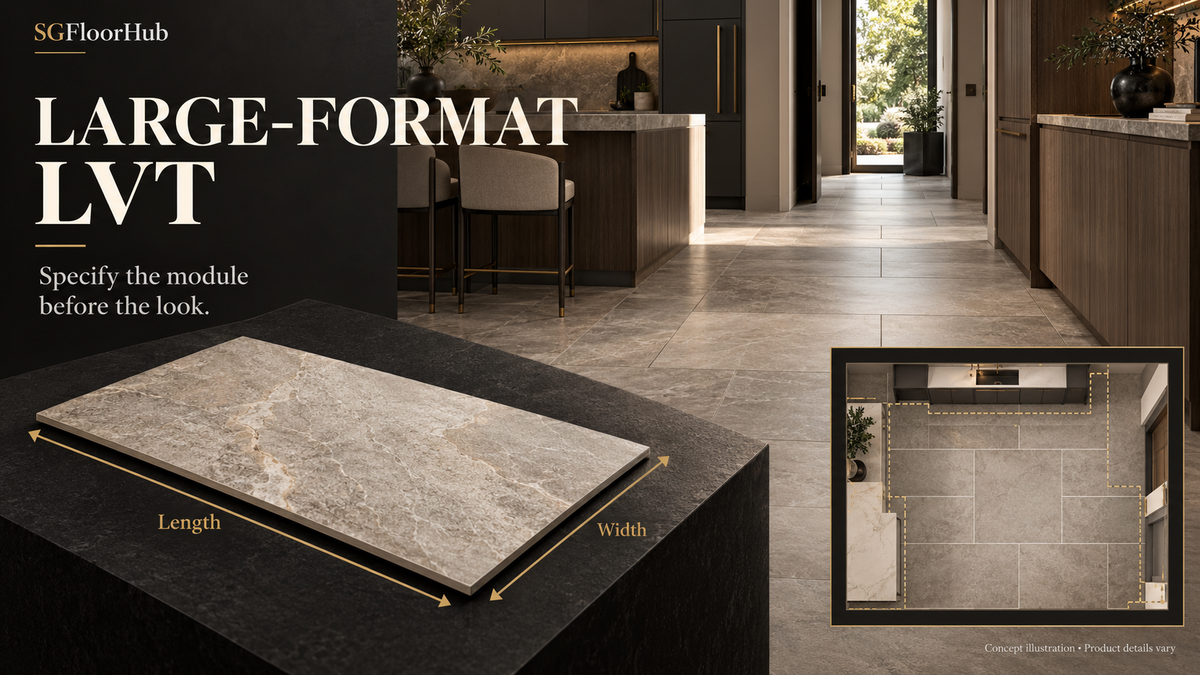
Large-format describes proportion, not a performance grade. Define the actual module and review how it meets the room edges and fixed features.
Quick answer
Large-format LVT has no useful meaning for a project until the actual length, width, format and edge detail are stated. Judge the proposed module against the room's visible dimensions and fixed features. A larger tile does not, on its own, establish greater strength or reduced substrate preparation.

Replace the size label with actual dimensions
Two suppliers can use “large-format” for different rectangles or squares. Start with the dimensions of the supplied unit, then distinguish the visible face from any overall measurement that includes a locking profile. Confirm the manufacturer's dimension convention instead of measuring a tongue and assuming it is usable face width.
Karndean's Sabbia Ceppo LM44 US page illustrates a stone-inspired LVT design offered in a stated rectangular format. The value of that example is the explicit format identification; it is not a universal threshold for what counts as large-format or evidence of Singapore availability.
Review the module where it meets the architecture
Draw the room and the proposed grid at a consistent scale. Include door openings, fixed cabinetry and the main viewing axis. Evaluate whether visible cuts support the intended composition. This is an appearance study, not an installer’s final set-out or an order quantity calculation.
| Review point | Ask this question |
|---|---|
| Open area | Can the viewer read enough complete modules to understand the pattern? |
| Perimeter | Do narrow visible cuts contradict the intended broad appearance? |
| Doorway | Does the grid change awkwardly between connected areas? |
| Edge treatment | Will the bevel or strip make the module more prominent? |
| Artwork | Does the stone or abstract design still work across several units? |
Fewer joint lines in a view do not automatically make a room feel larger. Furniture, lighting and the artwork's contrast can change the result. Compare drawings and samples instead of making a universal design promise.
Example: the biggest sample is not the best complete scheme
Imagine two fictional rectangular formats being considered for a small study. One gives a broad uninterrupted centre but produces a visually thin edge beside a full-height cabinet. Another shows more joints but creates a calmer perimeter. Either may be preferred; the room drawing makes the trade-off visible.
Before approving a room image, verify that its module matches the offered product. A render that stretches a small tile into a large slab can be attractive while misrepresenting what will arrive. Ask for at least one full-size tile and an adjacent-unit view, not only a cropped material swatch.
Keep format and performance on separate lines
Specify whether the tile is gluedown, loose-lay or rigid-core and retain its own product documents. Do not infer lock strength, suitability for a substrate or allowable installation conditions from the face dimensions. Those require the exact system's evidence.
For procurement, record the approved module, artwork reference, edge treatment and layout intention. If a supplier later offers the same colour in a smaller format, treat it as a visible design change rather than an automatic equivalent. The large-format brief is complete when someone can identify the unit and reproduce the intended grid without guessing from a marketing photograph.
Frequently asked questions
Is there one universal size that defines large-format LVT?
Do not rely on the label as a project dimension. State the actual supplied unit and the manufacturer’s measurement convention.
Will a larger tile hide an uneven base?
Size alone establishes no such capability. Substrate requirements come from the exact flooring system and its installation guide.
Sources and scope
Sources checked 15 October 2026. Manufacturer examples describe the named range and market; they do not confirm Singapore stock, local certification or approval for a particular project. Selection exercises and diagrams are original SGFloorHub editorial illustrations, not product tests or completed installations.
Continue reading
Written by SGFloorHub Editorial. Reviewed for scope, source attribution and product identification on 15 October 2026.
Independent editorial guidance. Check the current documents for the exact product and project.
Editorial standardsSuggest a correctionCONTINUE READING
More from this subject.

Vinyl Flooring
LVT Grout Effects: Printed Lines, Bevels or Separate Strips?
A grout effect may be printed, formed at the edge or made with a separate strip. Identify the detail before choosing the tile and layout.
Read article LVT Grout Effects: Printed Lines, Bevels or Separate Strips?
Vinyl Flooring
Vinyl Sheet Roll Widths: Understanding Product Options
Roll width is a supplied-product dimension that needs a matching design and construction reference. Learn how to read a real width example, distinguish nominal format from a lay...
Read article Vinyl Sheet Roll Widths: Understanding Product Options
Vinyl Flooring
Woven Vinyl Flooring: Reading the Weave and Backing
A textile-like appearance does not identify a woven floor. Examine the actual weave, backing, format and viewing direction as one product.
Read article Woven Vinyl Flooring: Reading the Weave and Backing