Vinyl Flooring
Attached Vinyl Backing: Foam, Cork and Other Constructions
An attached pad forms part of the specified vinyl product. Learn how to identify its material and role, keep it separate from the core, and check whether a proposed supporting layer or acoustic claim actually belongs to the offered assembly.
Quick answer
Attached backing is supplied as part of the vinyl product. Its material, thickness and role must be identified for the exact configuration. Foam, cork and other underside descriptions are not interchangeable, and an attached pad does not automatically approve a second underlay or establish an acoustic result.
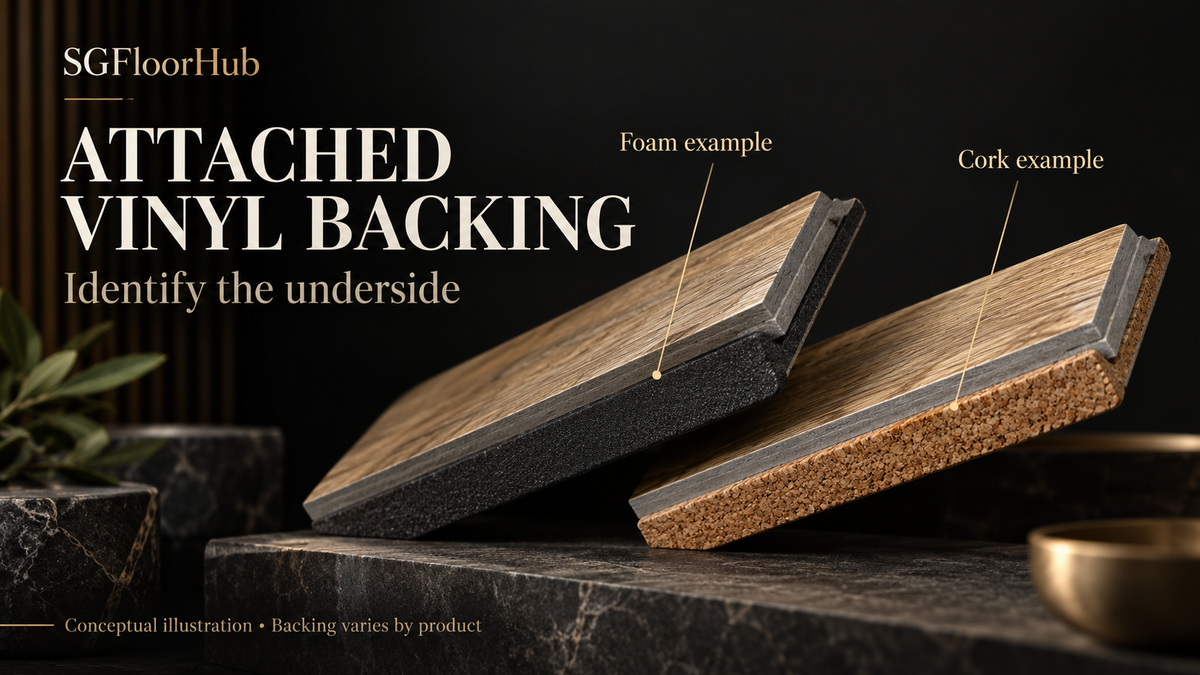
Cover: AI-generated SGFloorHub conceptual illustration of alternative attached foam and cork backings. Materials and thicknesses are illustrative, exaggerated for visibility and not to scale. These are separate backing examples, not a combined build-up or approval for additional underlay. Verify the exact product documentation.
Find the underside in the full construction
Begin with the manufacturer’s layer map. The core is a structural part of the board; an attached pad is a separate underside component where the product has one. A sales description of “cushion core” should not be silently rewritten as an attached-underlay specification.
Flooret’s Modin page identifies IXPE underlayment for its product. Karndean’s Australian format explanation describes a pre-attached acoustic foam backing for its rigid-core format. These examples identify named arrangements; they do not define the pad supplied on every SPC or click product.
If cork or another material is offered, obtain its exact construction statement. Do not identify the material from colour, roughness or a thumbnail image alone.

What changes when the underside changes
| Item | Review with the configuration |
|---|---|
| Installed build-up | Product and supporting layers, kept separate from overall gauge claims. |
| Connection and loading | The flooring manufacturer’s permitted support arrangement. |
| Acoustic evidence | Whether the backing in the report matches the supplied product. |
| Preparation | Substrate criteria still apply to the actual system. |
| Replacement | The same configuration and any compatibility limitations. |
This table is a review route, not a prediction that a particular pad will improve every property. The complete product and installation govern the result.
Example: an optional pad added to a padded plank
Editorial illustration: the floor has an attached layer and the proposal adds a loose pad called “premium”. The additional material needs written compatibility with the selected floor before its benefits are compared. Softer feel or a standalone pad brochure does not resolve that compatibility.
Ask the supplier to draw the actual sequence: base, preparation, any approved supporting layer, product and edge details. Identify which parts are factory supplied and which are site added. This prevents the attached pad from being counted twice in the description.
If a report describes a different backing or ceiling arrangement, retain that difference rather than advertising the result as the proposed assembly’s performance.
Approval and later substitutions
Keep the backing name with the product code and date. If a replacement carton has a different underside, treat it as a configuration question even when its colour matches. Resolve thickness, connection and supporting-layer implications before accepting it.
For Singapore procurement, confirm the supplied local configuration. International examples show why underside identity matters; they are not evidence that a particular pad material is available from your seller.
The backing article owns component identification. The general underlay guide owns approval of supporting layers, and the acoustic guide owns interpretation of results. Keeping these roles separate prevents three articles from repeating the same promises about comfort.
Frequently asked questions
Is an attached pad the same as the core?
No. Identify its position and role from the product construction.
Can any acoustic underlay go beneath it?
No. Use only the supporting arrangement permitted for the exact floor.
Does a pad guarantee a quiet installed floor?
No. Acoustic evidence must match the tested and proposed assembly.
Sources and scope
Sources checked on 14 October 2026. Manufacturer examples explain their named products and regions; they do not confirm Singapore stock or approval of your project. Labelled scenarios are editorial illustrations, not measurements or site investigations.
Continue reading
Written by SGFloorHub Editorial. Updated 14 October 2026. Editorial method · Suggest a correction
Independent editorial guidance. Check the current documents for the exact product and project.
Editorial standardsSuggest a correctionCONTINUE READING
More from this subject.

Vinyl Flooring
Large-Format LVT: Specify the Module Before the Look
Large-format describes proportion, not a performance grade. Define the actual module and review how it meets the room edges and fixed features.
Read article Large-Format LVT: Specify the Module Before the Look
Vinyl Flooring
LVT Grout Effects: Printed Lines, Bevels or Separate Strips?
A grout effect may be printed, formed at the edge or made with a separate strip. Identify the detail before choosing the tile and layout.
Read article LVT Grout Effects: Printed Lines, Bevels or Separate Strips?
Vinyl Flooring
Vinyl Sheet Roll Widths: Understanding Product Options
Roll width is a supplied-product dimension that needs a matching design and construction reference. Learn how to read a real width example, distinguish nominal format from a lay...
Read article Vinyl Sheet Roll Widths: Understanding Product Options