Vinyl Flooring
WPC Vinyl Cores: What the Construction Changes
WPC labels need a precise manufacturer description. This guide explains what a foamed core changes in the product structure, how it differs from an attached pad, and why comfort and acoustic claims still need evidence for the complete floor.
Quick answer
WPC is a manufacturer-used core label within vinyl flooring. Some ranges use a foamed construction, but the initials alone do not disclose a complete recipe or confirm wood content. Separate the core from the face and attached backing, then evaluate the exact product’s stated properties.
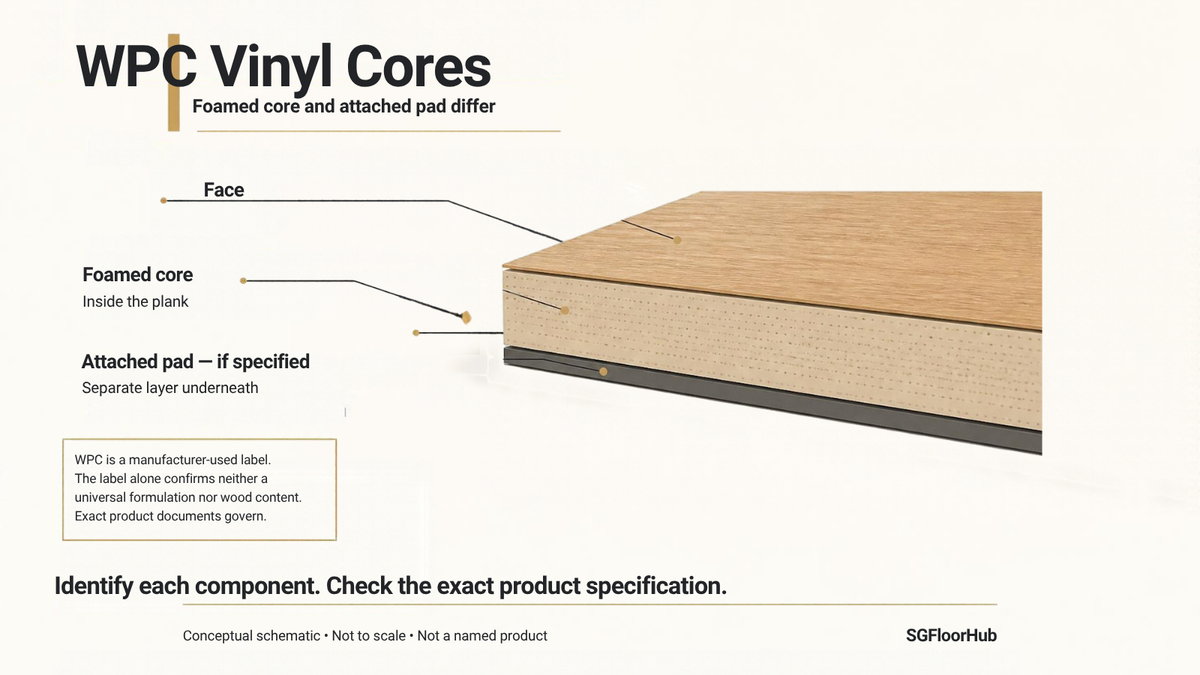
Cover: Original SGFloorHub editorial schematic created for this article. It is not to scale and does not depict a named-product cross-section or completed project.
Foamed core and attached foam are different locations
Shaw’s United States vinyl overview describes WPC as a plank with a foamed core. A core inside the board and a pad attached underneath are different components. Describing both as “foam” hides where each belongs in the product.
This distinction helps when comparing gauges. A thicker board can obtain part of that gauge from its core, while another product includes a different attached-pad thickness. Neither description tells you how much wearing surface exists. Keep the face, core and pad measurements in separate fields.
Do not assume the name WPC guarantees a particular wood-flour content. Use the named product’s disclosure. A generic acronym expansion is not a formulation sheet.

A cross-section reading framework
| Part | Separate question |
|---|---|
| Face | What wear layer and surface treatment are specified? |
| Core | How does the manufacturer describe the foamed or composite construction? |
| Connection | Which mechanical joint applies to the board? |
| Attached pad | What material and thickness are stated? |
| Complete product | Which use and performance documents cover this configuration? |
The framework identifies information, not the proportional thickness of any actual product. If a drawing is used, label it as schematic until the specific dimensions and layer names have been verified.
Example: a comfortable sample with incomplete evidence
Editorial illustration: one sample feels more cushioned when held or walked on in a showroom. That can support a preference about feel in those conditions. It does not establish an impact-sound result in a condo, a chair-use result or permission for an extra underlay.
Ask the supplier to identify whether the perceived feel relates to the complete construction, attached pad or showroom setup. Then compare the evidence for the required use. Keep personal observation separate from a measured claim.
COREtec’s tile portfolio includes WPC and other constructions within its United States range. The example demonstrates construction choice; it does not rank every WPC against every SPC product.
How to make the description useful in Singapore
A usable description says which product is offered, how the core is described, what the face and pad contain, and which installation documents apply. Obtain the regional specification for the supplied code instead of combining a local quotation with an unrelated overseas brochure.
For a home or office shortlist, finish the material identification before comparing quotations. If the supplier changes the pad or gauge while retaining the colour name, revisit the complete configuration.
This article addresses WPC construction. Whole-project comparisons, substrate assessment and cleaning belong to their existing specialist guides. Keeping those routes separate avoids repeating a generic buyer checklist each time a different core name appears.
Frequently asked questions
Does WPC always contain wood?
Do not infer a specific formulation from the initials. Read the exact manufacturer disclosure.
Is a foamed core the same as attached underlay?
No. They occupy different positions in the construction and need separate identification.
Does a softer sample prove better acoustics?
No. A feel observation is different from an acoustic result for a tested assembly.
Sources and scope
- Shaw Floors: vinyl construction terms, United States
- COREtec: tile core constructions, United States
Sources checked on 14 October 2026. Manufacturer examples explain their named products and regions; they do not confirm Singapore stock or approval of your project. Labelled scenarios are editorial illustrations, not measurements or site investigations.
Continue reading
Written by SGFloorHub Editorial. Updated 14 October 2026. Editorial method · Suggest a correction
Independent editorial guidance. Check the current documents for the exact product and project.
Editorial standardsSuggest a correctionCONTINUE READING
More from this subject.

Vinyl Flooring
Large-Format LVT: Specify the Module Before the Look
Large-format describes proportion, not a performance grade. Define the actual module and review how it meets the room edges and fixed features.
Read article Large-Format LVT: Specify the Module Before the Look
Vinyl Flooring
LVT Grout Effects: Printed Lines, Bevels or Separate Strips?
A grout effect may be printed, formed at the edge or made with a separate strip. Identify the detail before choosing the tile and layout.
Read article LVT Grout Effects: Printed Lines, Bevels or Separate Strips?
Vinyl Flooring
Vinyl Sheet Roll Widths: Understanding Product Options
Roll width is a supplied-product dimension that needs a matching design and construction reference. Learn how to read a real width example, distinguish nominal format from a lay...
Read article Vinyl Sheet Roll Widths: Understanding Product Options