Vinyl Flooring
Recycled Content in Vinyl: Where the Material Is Used
A recycled-content claim needs a location, a calculation basis and an identifiable product. Learn how to separate backing content from whole-product claims.
Quick answer
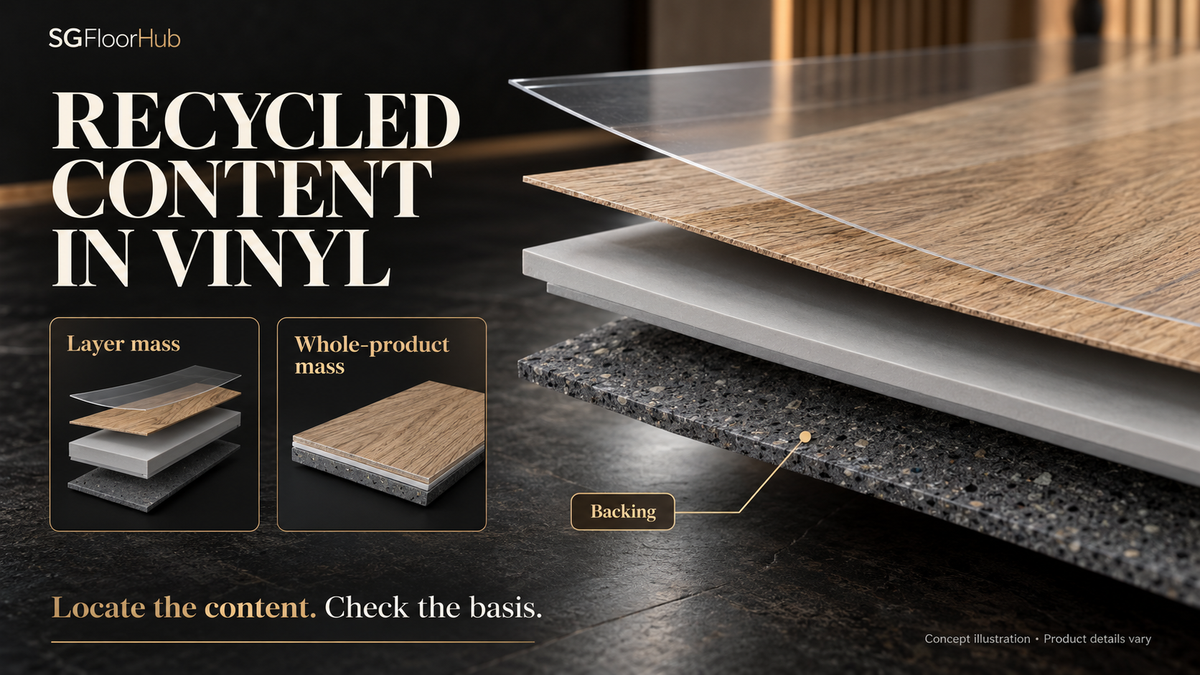
Recycled content can be incorporated into a particular vinyl layer rather than distributed throughout the whole floor. Ask which layer contains it, whether the percentage is by mass of that layer or the complete product, and which current document supports the figure. The percentage alone does not establish indoor-air performance or suitability.

Locate the content before comparing percentages
A quotation describing a floor as “30% recycled” leaves an important question unanswered: 30% of what? A backing-layer percentage and a whole-product percentage have different denominators. They cannot be placed in a comparison table as equivalent figures without clarification.
Forbo's US Allura information provides a useful construction example: recycled material is used in the backing of most ranges, with the manufacturer's own Allura scrap identified as the source. This illustrates a location-specific claim, not a universal recipe for vinyl flooring. Refer to the exact range's current environmental documentation when a numerical percentage matters.
Build a claim record with separate fields
| Field | What to record | Why it matters |
|---|---|---|
| Product identity | Manufacturer, range, format and code | Similar-looking variants may have different construction |
| Location | Backing, core or another named component | Prevents a layer claim becoming a whole-floor claim |
| Calculation basis | Whole-product mass or component mass | Establishes whether two percentages are comparable |
| Material source | Pre-consumer or post-consumer, as documented | Describes the origin rather than assumed quality |
| Evidence | Declaration, relevant EPD and validity details | Makes the wording traceable |
An environmental product declaration can contain useful composition information, but its declared unit and product coverage must be read. Do not transfer a figure from one thickness or factory to a different product merely because the brand matches.
An illustrative comparison: identical figures, different meanings
Imagine two fictional proposals. Product A reports 25% recycled content by total product mass. Product B reports 25% recycled content in its backing, with no backing mass stated. The correct response is not to rank them equally or calculate an invented whole-product figure for B. Keep B's denominator unresolved and request clarification.
Similarly, do not treat a broad “recyclable” statement as evidence that a Singapore collection service exists. Recycled input and a future recovery route answer separate questions. Ask the supplier to identify any applicable local scheme, accepted waste and collection conditions rather than assuming an overseas programme operates here.
Keep composition and performance evidence apart
Neither “virgin” nor “recycled” is a complete quality assessment. Surface clarity, emissions, dimensional behaviour and other properties need evidence covering the actual product. A backing-content declaration does not establish what the transparent wear layer contains; an emissions certificate does not establish a recycled percentage.
For a Singapore specification, preserve the manufacturer's original wording next to the selected code and record who supplied it. If only a collection-wide statement is available, label it that way. Leave unsupported numbers out of the project schedule until the document gap is resolved. This produces a defensible material description without turning one environmental attribute into a claim about everything the floor does.
Frequently asked questions
Does more recycled content automatically mean a better floor?
No. It describes one material attribute. Compare the calculation basis and assess the required product performance separately.
Can I use the backing percentage as the whole-floor percentage?
Only if the manufacturer explicitly states that basis. Otherwise keep the two quantities separate and request a whole-product declaration.
Sources and scope
Sources checked 15 October 2026. Manufacturer examples describe the named range and market; they do not confirm Singapore stock, local certification or approval for a particular project. Selection exercises and diagrams are original SGFloorHub editorial illustrations, not product tests or completed installations.
Continue reading
Written by SGFloorHub Editorial. Reviewed for scope, source attribution and product identification on 15 October 2026.
Independent editorial guidance. Check the current documents for the exact product and project.
Editorial standardsSuggest a correctionCONTINUE READING
More from this subject.

Vinyl Flooring
Large-Format LVT: Specify the Module Before the Look
Large-format describes proportion, not a performance grade. Define the actual module and review how it meets the room edges and fixed features.
Read article Large-Format LVT: Specify the Module Before the Look
Vinyl Flooring
LVT Grout Effects: Printed Lines, Bevels or Separate Strips?
A grout effect may be printed, formed at the edge or made with a separate strip. Identify the detail before choosing the tile and layout.
Read article LVT Grout Effects: Printed Lines, Bevels or Separate Strips?
Vinyl Flooring
Vinyl Sheet Roll Widths: Understanding Product Options
Roll width is a supplied-product dimension that needs a matching design and construction reference. Learn how to read a real width example, distinguish nominal format from a lay...
Read article Vinyl Sheet Roll Widths: Understanding Product Options