Vinyl Flooring
Mixed SPC Production Lots: Why Batch Identification Matters
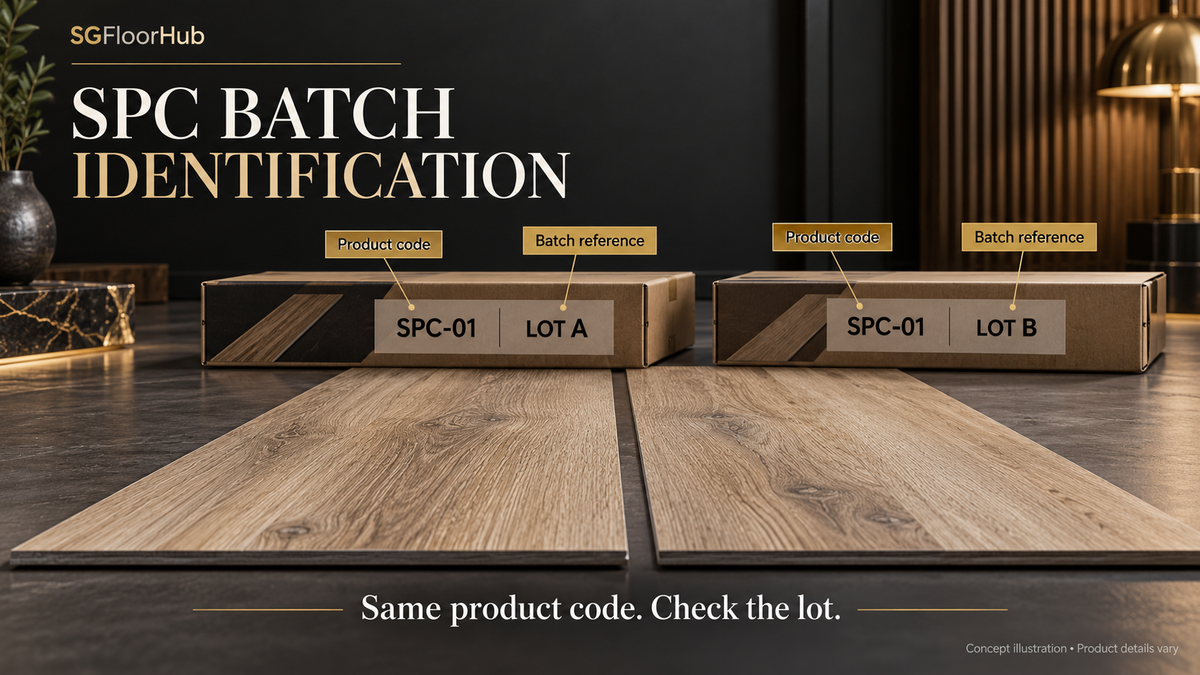
A production lot is different from the permanent SPC product code. Learn how to record carton references, review a mixed-lot proposal and distinguish batch-related questions from the intentional visual variation built into a printed collection.
Quick answer
A batch or production-lot reference identifies supplied material within a product, while the product code identifies the configuration. Keep both. If multiple lots are proposed for one visible area, obtain the manufacturer’s guidance and review representative material before accepting; neither a guaranteed mismatch nor a guaranteed match should be assumed for every range.

Separate three identities that can appear on a carton
| Identity | What it answers |
|---|---|
| Product / design code | Which configuration and decor are supplied. |
| Production lot or batch | Which production grouping the material belongs to. |
| Carton or logistics reference | How the package is tracked in the supply process. |
The exact fields and labels vary by manufacturer. Do not invent a decoding rule based on another brand’s carton. Photograph the complete label and ask the supplier to identify the relevant references.
Batch identity is not the same as printed-board variation. A collection may deliberately include several images within a design. Different printed pieces are therefore not automatic evidence that incompatible lots have been mixed.
Read a batch instruction within its product scope
Forbo’s Surestep Fast Fit February 2025 note instructs checks of colour and batch and discusses using material from the same lot. It is a sheet-vinyl example, not an SPC-specific instruction. It demonstrates the need to obtain the corresponding instruction for the actual SPC range rather than importing another product’s rule.
Flooret’s named SPC construction page supplies product identity for its range, but does not create a universal mixed-lot acceptance rule. A construction document and a batch instruction answer different questions.
Ask the supplier for the relevant SPC manufacturer’s policy or written project-specific clarification. Keep an unresolved mixed-lot proposal visible until that question is answered.

Example: topping up an order after layout changes
Editorial illustration: an order needs additional boards after the room scope changes. The supplier can offer the same product code from a later lot. Record both references and ask how the manufacturer advises handling a combined visible area. Do not assume the top-up is either defective or identical.
If visual review is needed, examine representative pieces together under the same conditions, with the codes and lots recorded. An approval of appearance remains an approval in that scope; it does not establish chemistry or every technical property.
Retain the accepted arrangement and any deliberate room boundary. Do not hide a lot change by renaming the colour or removing the label photographs.
Keep batch records useful for repairs
Label spare material with product and lot identity and retain the storage guidance. A later repair also compares an unused piece with a worn installation, so apparent difference cannot automatically be attributed to batch alone.
For Singapore procurement, confirm the actual carton supply before installation begins. Online catalogue images do not identify the lot that will arrive.
This article owns mixed-lot traceability for SPC. The product-code guide owns the sample-to-order chain; the appearance guide owns grain and print variation. Keeping those distinctions visible helps avoid three articles repeating one general sample-approval checklist.
Frequently asked questions
Is batch number the same as product code?
No. Keep them as separate identifiers.
Do two batches always look different?
Do not make a universal claim. Check the actual range’s guidance and representative material.
Does a printed pattern difference prove a batch problem?
No. Collections can include intentional print variation. Identify the product, lot and accepted visual range before drawing a conclusion.
Sources and scope
- Forbo: Surestep Fast Fit installation note, February 2025
- Flooret: Modin construction, United States
Sources checked on 14 October 2026. Manufacturer examples explain their named products and regions; they do not confirm Singapore stock or approval of your project. Labelled scenarios are editorial illustrations, not measurements or site investigations.
Continue reading
Written by SGFloorHub Editorial. Updated 14 October 2026. Editorial method · Suggest a correction
Independent editorial guidance. Check the current documents for the exact product and project.
Editorial standardsSuggest a correctionCONTINUE READING
More from this subject.

Vinyl Flooring
Large-Format LVT: Specify the Module Before the Look
Large-format describes proportion, not a performance grade. Define the actual module and review how it meets the room edges and fixed features.
Read article Large-Format LVT: Specify the Module Before the Look
Vinyl Flooring
LVT Grout Effects: Printed Lines, Bevels or Separate Strips?
A grout effect may be printed, formed at the edge or made with a separate strip. Identify the detail before choosing the tile and layout.
Read article LVT Grout Effects: Printed Lines, Bevels or Separate Strips?
Vinyl Flooring
Vinyl Sheet Roll Widths: Understanding Product Options
Roll width is a supplied-product dimension that needs a matching design and construction reference. Learn how to read a real width example, distinguish nominal format from a lay...
Read article Vinyl Sheet Roll Widths: Understanding Product Options