Vinyl Flooring
Heterogeneous Vinyl: Understanding the Layered Build-Up
Heterogeneous vinyl combines layers with different roles. This guide helps you identify the printed surface system, supporting construction and backing in a sheet product, while keeping total thickness and use evidence separate from its decorative appearance.
Quick answer
Heterogeneous vinyl combines layers with different functions, often including a printed design and a wearing surface. The complete build-up varies between compact, cushioned and other specified products. Read the exact construction rather than assuming every printed sheet uses the same support, backing or wear-layer measurement.
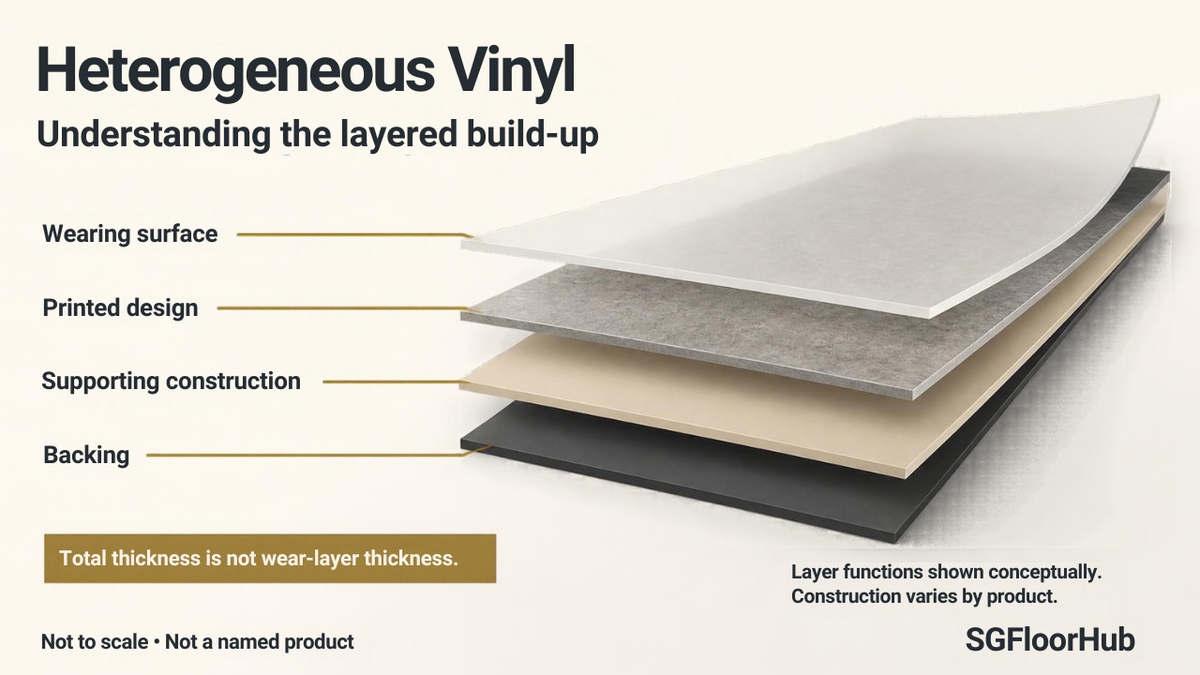
Cover: Original SGFloorHub editorial schematic created for this article. It is not to scale and does not depict a named-product cross-section or completed project.
Read the layers as a functional map
Tarkett’s heterogeneous-vinyl category identifies a multi-layer product with a printed design component. This is the core construction distinction; it is not a complete cross-section for every sheet in the category.
Ask which part carries the design, which part forms the wearing surface, which layers support stability and what underside is supplied. Record any named surface treatment separately. A generic brochure photograph should not stand in for those descriptions.
The total gauge may include cushioning or other supporting parts. It should not be relabelled as the clear wearing-layer thickness. A thicker sheet and a thicker surface layer are different propositions.

Compact and cushioned descriptions need their own fields
| Field | Reason to keep it separate |
|---|---|
| Overall thickness | Includes the complete manufactured product. |
| Wear-layer specification | Describes the stated wearing component, where applicable. |
| Printed design | Explains colour and pattern, not performance. |
| Carrier or reinforcement | Identifies the disclosed supporting arrangement. |
| Foam / backing | Can change the configuration and its supporting evidence. |
| Format | Roll dimensions and available design references. |
Forbo’s Eternal de Luxe range page provides a named sheet-product example with its own format information. Its specifications should be read for that product rather than transferred to another heterogeneous sheet.
Example: identical decor offered in two constructions
Editorial illustration: a supplier shows the same grey design in a compact and a cushioned format. The designs may coordinate visually, but the product configurations need separate identification. Ask for code, build-up, intended use and the relevant performance documentation for each.
A hand squeeze can help you observe softness, but it does not produce a residual-indentation or acoustic result. Keep that observation in an appearance/feel record, and use the stated test evidence for the technical comparison.
Where the project involves rolling furniture or another specific demand, identify which documentation addresses it. Do not assume that a cushion component improves every performance characteristic.
A useful material schedule
Keep the collection, design reference, construction version, supplied format and source document in one schedule. If a matching wall covering is suggested, identify its separate approval; a floor’s construction does not establish suitability on a wall.
For Singapore procurement, confirm the specification and supply arrangement for the actual offer. An international category page explains terminology, while a local product document should identify what will arrive.
This guide stops at the layered construction. The roll-width article explains supplied format, technical guides explain test interpretation, and installation or care guides address the completed system. Avoid turning each layer description into another general vinyl-selection article.
Frequently asked questions
Is heterogeneous vinyl always printed?
Printed design is a common feature in the manufacturer category example. Verify the exact product’s construction rather than using the category as its complete specification.
Is total sheet thickness the wear layer?
No. Identify the wearing component separately from the complete build-up.
Does a cushion layer guarantee better performance?
It changes the product configuration. Compare evidence for the particular property you need.
Sources and scope
Sources checked on 14 October 2026. Manufacturer examples explain their named products and regions; they do not confirm Singapore stock or approval of your project. Labelled scenarios are editorial illustrations, not measurements or site investigations.
Continue reading
Written by SGFloorHub Editorial. Updated 14 October 2026. Editorial method · Suggest a correction
Independent editorial guidance. Check the current documents for the exact product and project.
Editorial standardsSuggest a correctionCONTINUE READING
More from this subject.

Vinyl Flooring
Large-Format LVT: Specify the Module Before the Look
Large-format describes proportion, not a performance grade. Define the actual module and review how it meets the room edges and fixed features.
Read article Large-Format LVT: Specify the Module Before the Look
Vinyl Flooring
LVT Grout Effects: Printed Lines, Bevels or Separate Strips?
A grout effect may be printed, formed at the edge or made with a separate strip. Identify the detail before choosing the tile and layout.
Read article LVT Grout Effects: Printed Lines, Bevels or Separate Strips?
Vinyl Flooring
Vinyl Sheet Roll Widths: Understanding Product Options
Roll width is a supplied-product dimension that needs a matching design and construction reference. Learn how to read a real width example, distinguish nominal format from a lay...
Read article Vinyl Sheet Roll Widths: Understanding Product Options