Vinyl Flooring
Flexible LVT Planks: Reading Their Construction
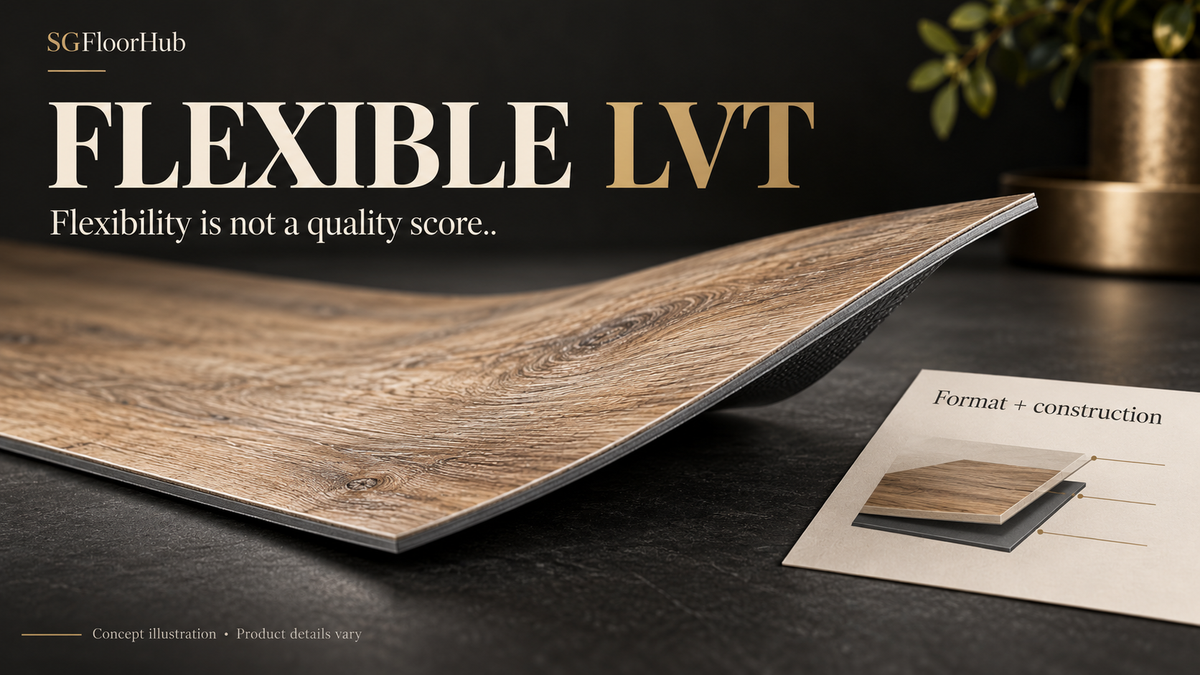
Flexibility is an observable behaviour, not a complete quality verdict. Learn how to read a flexible LVT construction, distinguish it from a fixing-method label and avoid unsupported conclusions from bending or handling a small sample.
Quick answer
Flexible LVT describes a product behaviour and construction that needs its own manufacturer identity. A flexible plank is not automatically low quality, loose lay or suitable over an unprepared base. Read the format, face, support and underside, and use relevant evidence rather than an informal bending comparison.

Separate flexibility, format and quality
Flexibility concerns how a piece responds to handling. Format concerns the manufacturer’s product and fixing arrangement. Quality or suitability requires relevant evidence against a brief. Those three ideas should not be collapsed into a single hand demonstration.
Karndean’s LooseLay range and its gluedown-format explanation illustrate different product arrangements. A flexible sample alone does not tell you which one is being offered, and their supporting requirements cannot be inferred from softness.
The useful description names the product and states its construction before making a claim. If the supplier uses “flexible” only as a sales term, ask which format and documents identify the actual floor.
What a hand sample can and cannot answer
| Sample exercise | Useful observation | Unsupported conclusion |
|---|---|---|
| Ordinary handling | The piece appears flexible in that condition. | A universal durability ranking. |
| Viewing the edge | Visible interfaces and underside features. | Exact chemistry or hidden reinforcement. |
| Comparing labelled products | Different feel or appearance. | Equivalent use or installation requirements. |
| Reviewing the document | Named format and measured properties. | That an unrelated range shares those values. |
Avoid extreme bending, heat or improvised loading as proof of performance. Such exercises may damage a sample without reproducing a recognised test or the conditions of an installed floor.
Example: a flexible sample rejected as “too thin”
Editorial illustration: a buyer compares a flexible gluedown sample with a thicker rigid product and assumes the first is inferior. The comparison has mixed format and gauge with a quality conclusion. Identify the complete systems and evidence before deciding which fits the room.
The flexible product may be a legitimate specified construction, while the rigid product may need different edges or supporting arrangements. That does not prove either is the better choice; it explains why a sample’s bend is an incomplete decision basis.
Ask which property matters: appearance, wearing surface, chair use, installed height or another requirement. Compare that property using the corresponding product evidence, not one demonstration used to answer every question.
Where this construction article stops
Once identified, the product should be read with its own installation and care instructions. Flexibility does not approve a damp, loose or irregular base. Keep substrate readiness as a separate assessment.
For Singapore procurement, match the offered code and supplied specification. An overseas product example explains format differences; it does not establish local availability or a project approval.
This article owns the limits of interpreting flexibility. The cross-section guide owns visible structure, and the dryback or loose-lay guides own their specific formats. If a future brief merely repeats those answers, merge it instead of creating another article to preserve the planned count.
Frequently asked questions
Does flexible mean low quality?
No. Use relevant product evidence and intended-use requirements rather than a bend as a quality score.
Is flexible LVT always loose lay?
No. Identify the manufacturer’s actual format and fixing arrangement.
Does flexibility let the floor follow any uneven base?
Do not assume so. The selected installation system still has substrate acceptance requirements.
Sources and scope
Sources checked on 14 October 2026. Manufacturer examples explain their named products and regions; they do not confirm Singapore stock or approval of your project. Labelled scenarios are editorial illustrations, not measurements or site investigations.
Continue reading
Written by SGFloorHub Editorial. Updated 14 October 2026. Editorial method · Suggest a correction
Independent editorial guidance. Check the current documents for the exact product and project.
Editorial standardsSuggest a correctionCONTINUE READING
More from this subject.

Vinyl Flooring
Large-Format LVT: Specify the Module Before the Look
Large-format describes proportion, not a performance grade. Define the actual module and review how it meets the room edges and fixed features.
Read article Large-Format LVT: Specify the Module Before the Look
Vinyl Flooring
LVT Grout Effects: Printed Lines, Bevels or Separate Strips?
A grout effect may be printed, formed at the edge or made with a separate strip. Identify the detail before choosing the tile and layout.
Read article LVT Grout Effects: Printed Lines, Bevels or Separate Strips?
Vinyl Flooring
Vinyl Sheet Roll Widths: Understanding Product Options
Roll width is a supplied-product dimension that needs a matching design and construction reference. Learn how to read a real width example, distinguish nominal format from a lay...
Read article Vinyl Sheet Roll Widths: Understanding Product Options